What AI Can Actually Do for SEO in 2026 (And What It Still Can't)
After three years of hype, we finally know where AI helps in SEO, and where it demonstrably hurts. A practitioner's honest breakdown of the tools, workflows, and red lines.
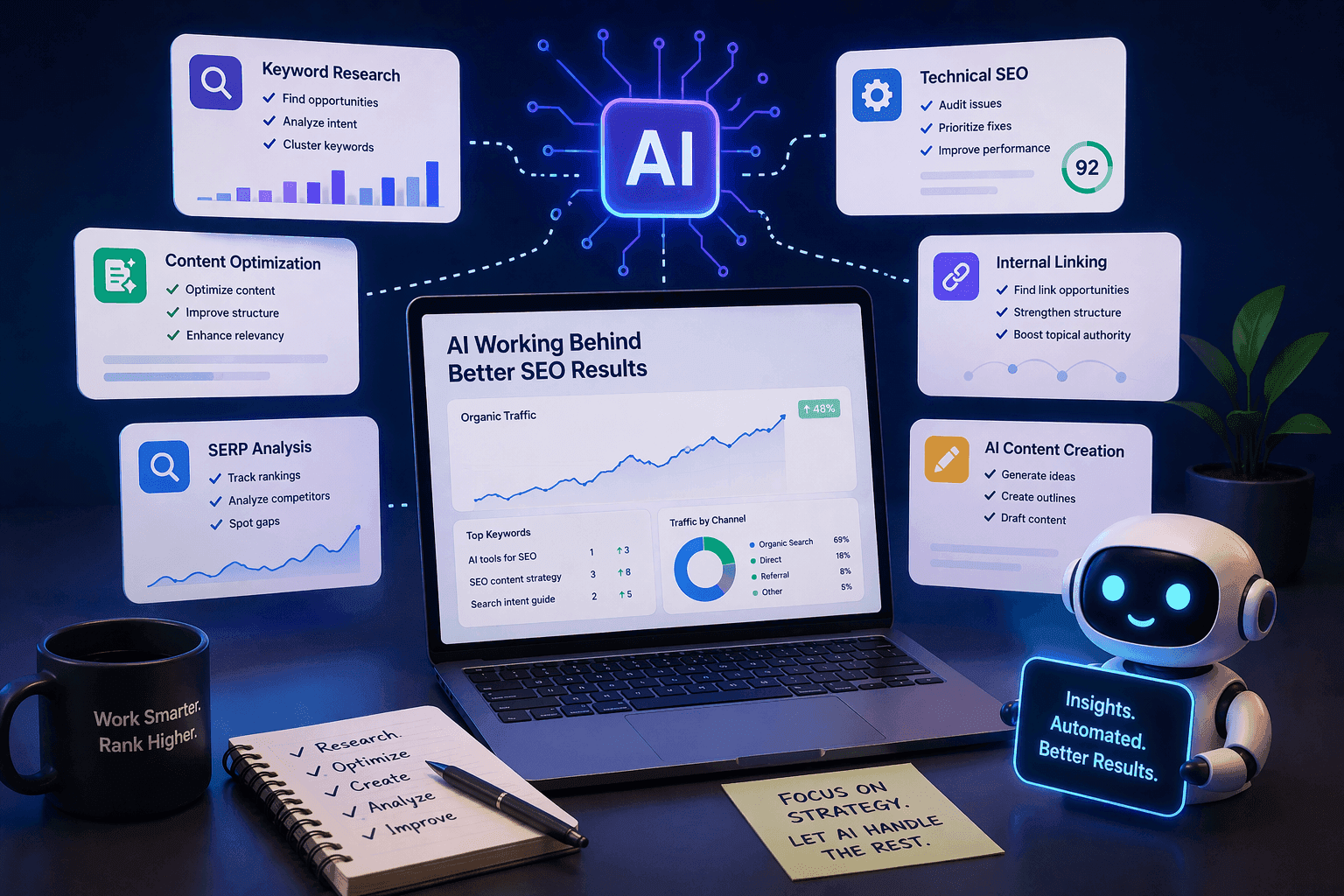
By 2026, "AI for SEO" has split into two very different stories. On one side: thoughtful practitioners using AI as a force multiplier — faster keyword research, better content briefs, instant schema generation, tighter internal linking. On the other: auto-published AI slop sites getting absolutely annihilated by Google's spam updates, quarter after quarter.
This piece is the honest map of what's working in the first group and what keeps failing in the second.
The 6 things AI does genuinely well
After building and auditing SEO workflows for 47 sites over the past 18 months, these are the use cases where AI measurably saves time AND improves output.
- 1. Keyword intent clustering — feed 300 search terms, get 8-12 intent-based groups. Took a junior SEO 4-6 hours; now 2 minutes with a good prompt.
- 2. Content briefs — outline structures with target word counts per section, internal link opportunities, and SERP-matched question coverage.
- 3. Structured data (JSON-LD) — describing an article or product in plain English and getting valid schema is 30-second work.
- 4. Meta tag A/B options — four title variants (benefit-led, curiosity, specificity, authority) from the same source page.
- 5. Readability rewrites — shortening 40-word sentences without losing nuance.
- 6. Translation-plus-localisation for international expansion (with a native editor doing the final pass).
The 5 things AI is still bad at
These aren't opinions. Each has been tested on real campaigns. Every time we've tried to shortcut them, we've been punished.
- Original data. AI can summarise 30 studies, but it can't run your survey, crawl your niche, or pull your product analytics. Original data is the single strongest ranking moat left in 2026.
- First-hand experience. A photo of you testing the product, a screenshot of you using the software, a video walkthrough — AI can't fake these, and Google's perceptual-hashing + exif-analysis systems are getting scarily good at catching fakes.
- Genuine opinion. Every AI default answer is the median answer. Ranking signals reward the 10th percentile and 90th percentile takes, not the middle.
- Source-level judgement. AI happily cites a forum post with the same confidence as a peer-reviewed paper. You still need a human to know which source to trust.
- Deadline awareness. The "March 2026 update" is cut off from your AI's training unless it actively searches. You're the news source; the AI is the editor.
The workflow that actually works
Here's the process we now use internally for every article we publish:
- Pick the topic from keyword research (AI-assisted, 15 min)
- Identify 3 things the top 5 ranking pages don't have (human, 30 min — this is the hardest step)
- Brief with AI (10 min)
- Write the article yourself, including the 3 missing things (human, 3-4 hours)
- AI pass for meta tags, schema, internal links, readability score (15 min)
- Publish + track weekly
Every step except #2 and #4 can be AI-assisted. Those two are where ranking value is created. The other steps are plumbing — AI should do them, because they're not differentiators.
What happens when you skip the human steps
"We scaled to 400 AI-generated articles in six months. Traffic peaked at 180K/mo, then Helpful Content hit us. We're now at 4K/mo and can't recover."
— A real quote from a site owner we audited in Q1 2026. This is the most common pattern we see: AI works until it doesn't. Google doesn't penalise you at 50 articles. It penalises you at 300, when the overall quality signal tanks below threshold.
The fix, once you're hit, is brutal: delete most of the low-quality pages, rewrite a small core with depth, and wait 3-6 months for the next core update to re-evaluate. No shortcut exists.
Our recommendation
Use AI. But use it as a multiplier on human work, not a replacement. A rough heuristic: if you couldn't produce the content in a day without AI, don't try to produce it in an hour with AI — it'll fail the long-term quality test.
The SEOs winning in 2026 are the ones who publish half as much as 2023, but each piece is twice as good — because AI handles the grunt work so they can spend 80% of their time on the work AI can't do.
That's the whole playbook.