Google May 2026 Core Update: What to Expect, Ranking Changes & SEO Impact
Google’s May 2026 Core Update may cause major ranking fluctuations, visibility changes, and AI-content reevaluations across search results globally.
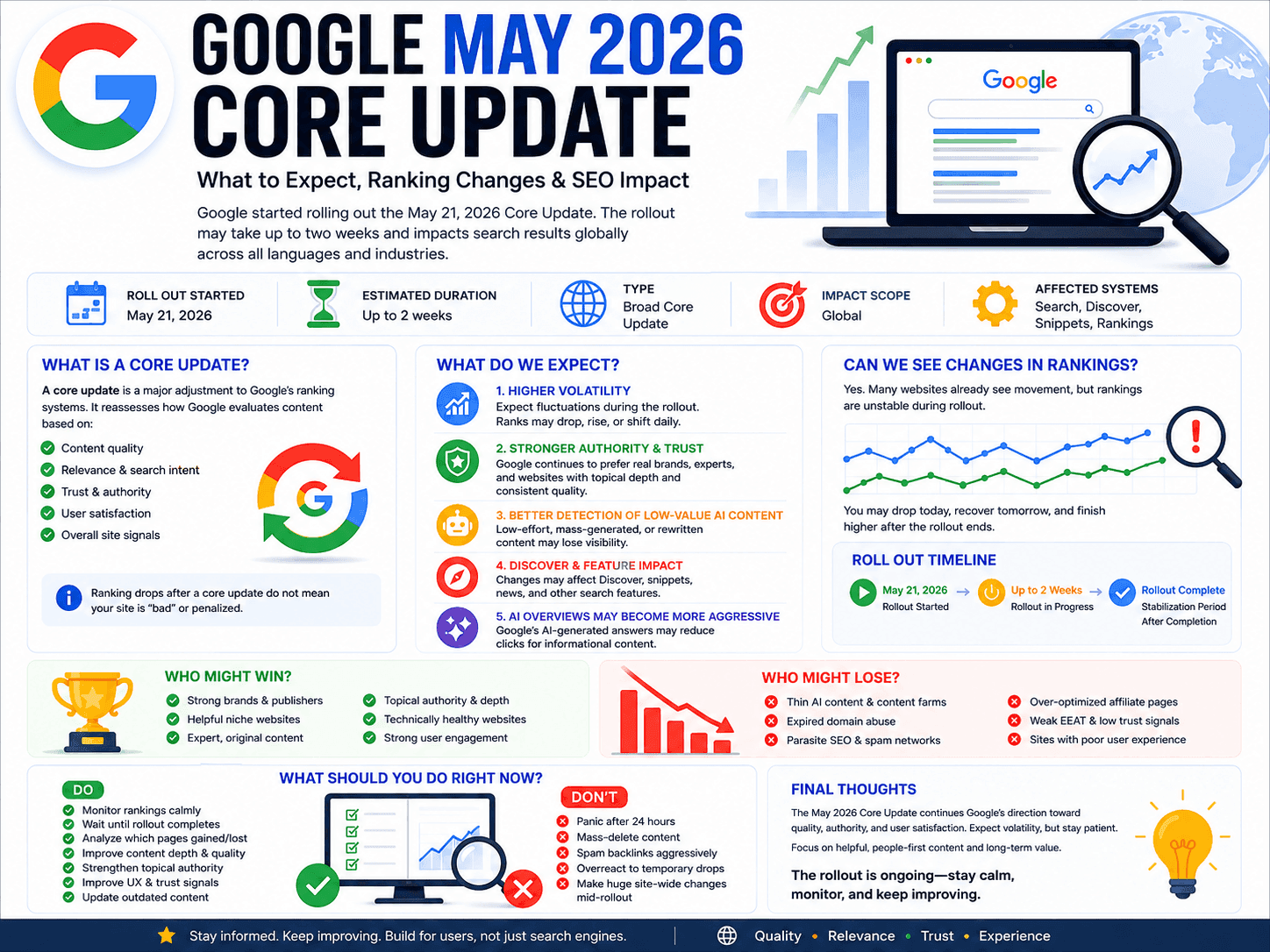
Google officially started rolling out the May 2026 Broad Core Update on May 21, 2026. According to Google, the rollout may take up to two weeks and affects search results globally across all languages and industries.
Google described it as a “regular update designed to better surface relevant, satisfying content for searchers.”
What Is a Google Core Update?
A core update is a major adjustment to Google’s ranking systems. Unlike spam penalties or manual actions, core updates are broad changes to how Google evaluates:
- Content quality
- Relevance
- Trust
- User satisfaction
- Authority
- Search intent matching
- Overall site signals
These updates can dramatically reshuffle rankings, even for older and established websites. Google itself says that ranking drops after a core update do not necessarily mean a site is “bad” or penalized.
Timeline of the May 2026 Core Update
EventDate
Rollout started
May 21, 2026
Estimated rollout duration
Up to 2 weeks
Type
Broad Core Update
Impact scope
Global
Affected systems
Search, Discover, snippets, rankings
What Do We Expect From This Update?
Although Google never reveals the exact algorithm changes, SEO data and previous updates suggest several major patterns.
1. Higher Ranking Volatility
During core updates, ranking fluctuations are normal. Some websites may see:
- Sudden drops
- Massive visibility gains
- Daily position changes
- Keyword reshuffling
- Temporary instability
The March 2026 Core Update already caused unusually high SERP volatility, with reports showing nearly 80% movement in some top search positions.
That means the May update could continue refining or expanding those same systems.
2. Stronger Emphasis on Authority & Trust
Recent Google behavior suggests a continued preference for:
- Real brands
- Established publishers
- Expert-written content
- Topically authoritative websites
- Sites with consistent quality history
Some SEO analysts observed that broader authority signals started outweighing simple page-level optimization after recent updates.
This means:
- Thin affiliate sites may struggle
- AI-scaled content farms may lose visibility
- Generic SEO articles may decline
- Specialized websites with topical depth may gain
3. Better Detection of Low-Value AI Content
Google recently updated spam documentation to explicitly mention attempts to manipulate AI-driven search systems.
This is important because 2025–2026 saw a massive rise in:
- Programmatic AI pages
- Mass-generated SEO articles
- Low-effort “best” listicles
- Auto-scaled content networks
The May 2026 update may further reduce visibility for:
- Rewritten AI spam
- Pages without original value
- Thin informational content
- Sites relying only on keyword optimization
AI-generated content itself is not the problem. The issue is low-quality or unhelpful content.
4. Google Discover May Also Change
Core updates frequently impact:
- Google Discover
- Featured snippets
- News visibility
- AI Overviews
- Rich results
Google confirmed that core updates can affect Discover and other search features.
Websites relying heavily on Discover traffic could see:
- Traffic spikes
- Major declines
- Content visibility changes
- Lower click-through rates
5. AI Overviews Could Become More Aggressive
Google’s AI search ecosystem continues evolving rapidly.
Recent research on AI Overviews showed:
- Google increasingly synthesizes answers directly
- Some cited sources do not even rank on page one
- AI-generated summaries reduce publisher clicks significantly
This may influence:
- Informational keyword traffic
- FAQ content
- Simple how-to articles
- Generic definitions
Sites with strong branding and unique expertise may perform better than generic informational pages.
Can You See Ranking Changes Immediately?
Yes.
Some websites already report:
- Sudden traffic spikes
- Keyword drops
- SERP reshuffling
- Indexing anomalies
- Discover fluctuations
However, rankings during rollout are unstable. A site may:
- Drop today
- Recover tomorrow
- Finish higher after rollout ends
It is very common to see daily fluctuations until the rollout completes.
Which Websites Are Most Likely To Be Affected?
Potential Winners
- Strong brands
- Helpful niche sites
- Real expert content
- Sites with topical authority
- Fast and technically healthy websites
- Websites with strong user engagement
Potential Losers
- Thin AI content sites
- Expired domain abuse
- Parasite SEO
- Over-optimized affiliate pages
- Spammy guest post networks
- Websites with weak EEAT signals
- Sites relying only on backlinks without real value
Important: Old Domains Are NOT Automatically Safe
One major misconception is:
“My domain is old, so it’s protected.”
That is false.
Google now heavily evaluates:
- Current usefulness
- Content quality
- User satisfaction
- Brand trust
- Topic consistency
Even 10+ year-old domains can lose rankings if Google decides competitors provide more satisfying results.
What Should Website Owners Do Right Now?
DO:
- Monitor rankings calmly
- Wait until rollout completes
- Analyze which pages gained/lost
- Improve content depth
- Strengthen topical authority
- Remove low-value pages
- Improve UX and trust signals
- Update outdated articles
DON’T:
- Panic after 24 hours
- Mass-delete content immediately
- Spam backlinks aggressively
- Overreact to temporary drops
- Make huge site-wide changes mid-rollout
Google itself recommends focusing on “helpful, reliable, people-first content.”
Final Thoughts
The May 2026 Core Update appears to continue Google’s broader direction from recent updates:
- More emphasis on quality and authority
- Stronger filtering of low-value AI content
- Greater ranking volatility
- Increased influence of AI-driven search systems
- More importance placed on trust and topical depth
For some websites, this update may bring major growth opportunities.
For others, especially those relying on scaled SEO tactics without real value, visibility losses may become more noticeable over the next few weeks.
The most important thing now is patience:
the rollout is still ongoing, and rankings may continue shifting daily until Google finishes deployment.