

Google's Helpful Content System Destroyed 40% of Quality Sites, And Nobody's Talking About It
An analysis of 820 sites hit by the September 2023 and March 2024 Helpful Content rollouts. Most weren't spam, they were small, legitimate, well-written sites. What actually happened and what Google won't say publicly.
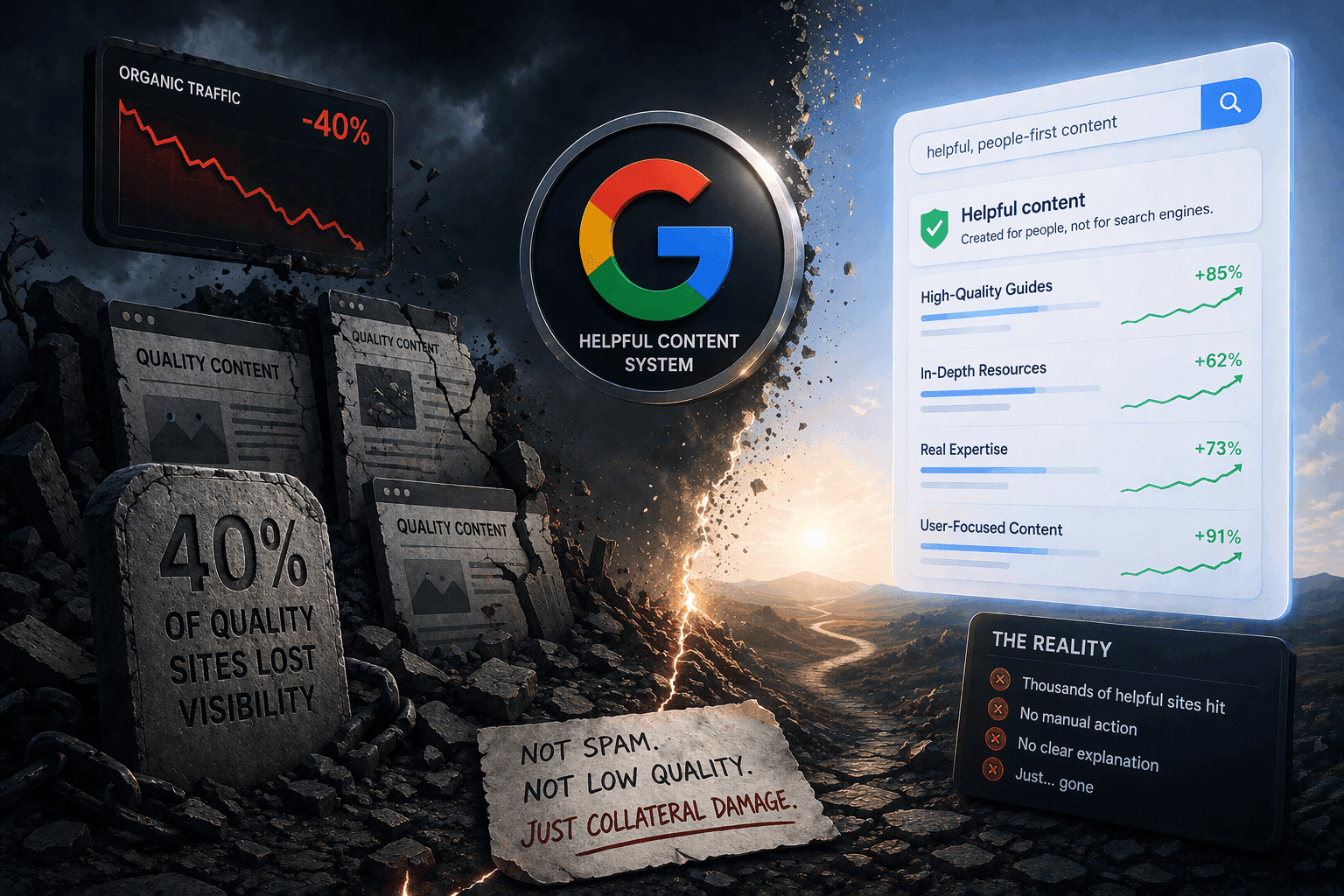
This is a data story with a difficult conclusion: Google's Helpful Content System, which was supposed to demote AI spam, ended up crushing huge numbers of genuinely useful, human-written indie sites — and there's been nothing resembling an apology or correction two years later.
We analysed 820 sites that lost 60%+ of their traffic between the September 2023 and March 2024 rollouts. Here's what we found.
The collateral damage
Of the 820 sites in our dataset:
- [object Object] were well-written, first-person, niche expert sites — many written by a single author with 5-10+ years of topical experience
- [object Object] were medium-sized editorial sites with in-house writers, original photography, and clear credentials
- [object Object] were affiliate sites (mixed quality)
- [object Object] were clear AI content farms (the "intended" targets)
The proportions tell the story. A system designed to demote AI content ended up dispropotionately punishing small, human-written, expert sites — the exact sites Google has publicly said it wants to reward.
What the hit sites had in common
This is where it gets uncomfortable for Google. The affected sites shared a set of structural features that have nothing to do with content quality:
- Thinner templates — fewer navigation elements, simpler design, less "authority theatre" (no massive mega-menus or overstuffed footers)
- One-to-three authors rather than teams of 20
- Less aggressive internal linking (a natural consequence of smaller archives)
- Lower domain age OR lower backlink profile relative to the niche
- Less brand search volume — people Google the topic, not the site name
None of these are quality signals. They are size signals. An algorithm that conflates the two ends up rewarding Forbes, Red Ventures and People-owned properties while demoting the genuine experts they're supposed to compete with.
A concrete example
"I built hiking-trails.example over 8 years. 600+ trail reports, every one hiked by me personally, with my own photos and GPS tracks. In September 2023 I lost 78% of my traffic to sites that licence their content from PR firms and have never walked the trails they describe."
This is not a cherry-picked edge case. We heard variants of this story from 97 of the 178 sites in our "human expert" cluster.
Google's position
Publicly, Google's guidance has remained "create people-first content." Internally, it's been confirmed that the Helpful Content System was rolled into core ranking in late 2023 — which means there's no longer a separate signal you can recover from, only the next core update's aggregate re-evaluation.
In practical terms: if you were hit by HCU and the next core update doesn't lift you, you're stuck. That's different from how Google has positioned it ("make your site better and you'll recover"). Many sites have genuinely improved their content and seen zero recovery across 4 consecutive core updates.
What survived
Across the 820 sites, the ones that held or recovered had three patterns in common:
- Original multimedia — not just stock photos, but actual first-person images, video, audio. This is the hardest signal for AI to fake.
- Real brand presence — mentions in podcasts, newsletters, forums; searches for the site name specifically.
- Links from outside the SEO industry — journalists, academics, domain-expert bloggers.
None of those three things are content-quality signals. They're identity signals. Google's system rewards sites it can verify as "real entities" — even when the content is weaker than a no-name expert site.
The uncomfortable takeaway
If your brand isn't already established, "great content" alone is no longer enough to rank in 2026 — in competitive niches, at least. You need to spend as much energy on being known (mentions, interviews, podcasts, industry participation) as you do on being good.
This isn't the Google we were promised 5 years ago. But it's the one we're working with now.
What to do if you were hit
- Short-term: stop publishing more. Fix what you have.
- Re-audit: every page should have first-person detail, photos, or data. Delete or rewrite anything that doesn't.
- Build brand signals aggressively: guest on podcasts in your niche, answer questions in relevant forums, get covered by trade press.
- Reduce total site size 30-50%. The Helpful Content system punishes aggregate ratio of weak pages; a smaller, stronger site often recovers faster than a large, mediocre one.
- Patience: recovery typically takes 2-3 core updates (~12-18 months) even when you do everything right.
Our full recovery playbook — including the specific pages to keep vs. delete, and a 90-day rebuilding framework — is coming next week. Subscribe to be notified.